


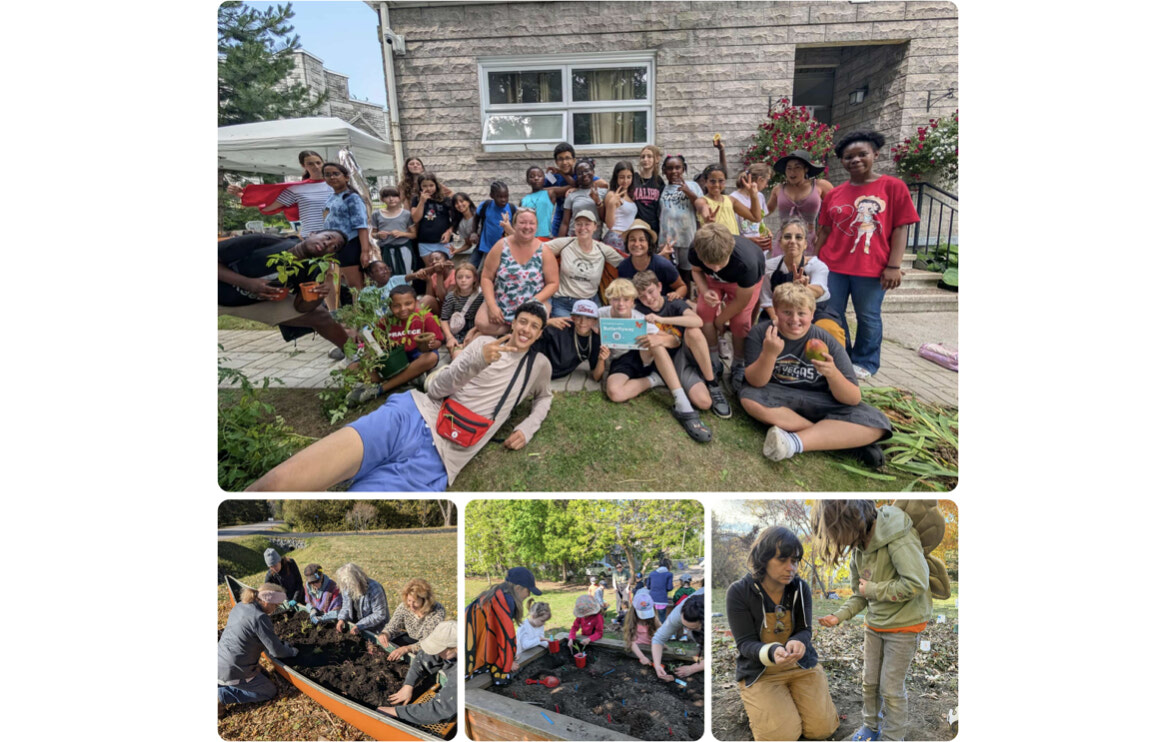
Aylmer resident Ioana has sparked a fast-growing grassroots movement to restore local biodiversity through Pollinate Aylmer, a volunteer-led initiative turning lawns and community spaces into pollinator-friendly gardens as part of the David Suzuki Foundation’s Butterflyway Project. Photo: Courtesy
Pollinate Aylmer takes root
Tashi Farmilo
Pollinate Aylmer, a grassroots volunteer network, has spent the last six months converting lawns and underused community green spaces into native pollinator gardens as part of the David Suzuki Foundation’s Butterflyway Project. Founded in spring 2025 by Aylmer resident Ioana, the initiative now includes 12 "pollinator stops" across the neighbourhood and continues to expand with support from residents, schools and organizations.
The project began as a deeply personal effort. Ioana, a mother of three, was diagnosed several years ago with neuro-Behçet’s disease, a rare condition that affected her memory and physical stamina. Gardening became a form of recovery and a way to reconnect with nature. “I gained strength slowly with my hands covered in dirt,” she said. “Plants helped me come to terms with a new version of myself.”
After moving to a property in Aylmer North, Ioana began growing native plants and created “Localeaf”, a backyard nursery. When she learned about the Butterflyway Project’s call for new volunteer rangers, she applied and was surprised to learn she was the first and only one in the region. “I love this little town,” she said. “I’ve always had this feeling that it needs something of its own. Not Gatineau. Not Ottawa. Just Aylmer.”
What started as a solo effort quickly grew when Ioana invited others to join her through a local gardening group. The response led to the formation of Pollinate Aylmer, a tight-knit group of volunteers united by a shared commitment to community, education, and environmental healing. “We talked about native plants, and about starting a community,” she said. “What really drives us is a desire for connection and compassion.”
In their first season, Pollinate Aylmer planted gardens at Eardley Elementary, Jardin Collectif Nord, and the Aylmer Food Bank. At Eardley, nearly every student participated in a workshop where they planted seedlings with names like purple lovegrass and mad dog skullcap. “Our volunteers showed up wearing butterfly wings, with balls of pollen stuck to us,” said Ioana. “We spent an hour with each class helping them plant and talking about building pollinator habitat.”
With no funding, the group has relied on creative reuse. Volunteers sourced discarded election signs for garden markers, collected old plant pots, and built nursery displays out of donated pallets and milk crates. “We had what we started calling ‘potting parties’ in my backyard,” she said. “We’d sit under a tree, potting seedlings, learning about the plants, and talking. We became friends.”
This winter, Pollinate Aylmer will launch a series of free workshops in collaboration with Partenaires du Secteur Aylmer, focused on helping residents grow native plants from seed at home. The group will also host Aylmer’s first Seedy Saturday event in February 2026, inviting the community to share heirloom and native seeds. “Our vision for it is purely by Aylmer, for Aylmer,” said Ioana. “Anyone who wants to donate seeds, knowledge, time, or expertise is welcome and embraced.”
Localeaf will continue to supply native plants, including more than 100 species of trees, shrubs, grasses and flowers grown from seed. The nursery has also begun exploring the propagation of rare and endangered native species. “We’re preparing tree and shrub seeds for the growing season,” said Ioana. “So many edible berries, fruits, and nuts for us and for our local wildlife.”
Looking ahead, the group’s vision includes creating more pollinator stops throughout Aylmer and supporting residents who want to convert even small patches of lawn into biodiverse habitat. “People don’t realize the impact they can make without anyone else’s permission,” said Ioana. “It can start with a single garden bed, or even a container on a balcony.”
For a project that began with one woman’s illness and a few handfuls of seeds, the growth of Pollinate Aylmer has been rapid and meaningful. “It’s been six months since we first came together,” said Ioana. “And we just keep thinking, wow—look how far we’ve come.”