


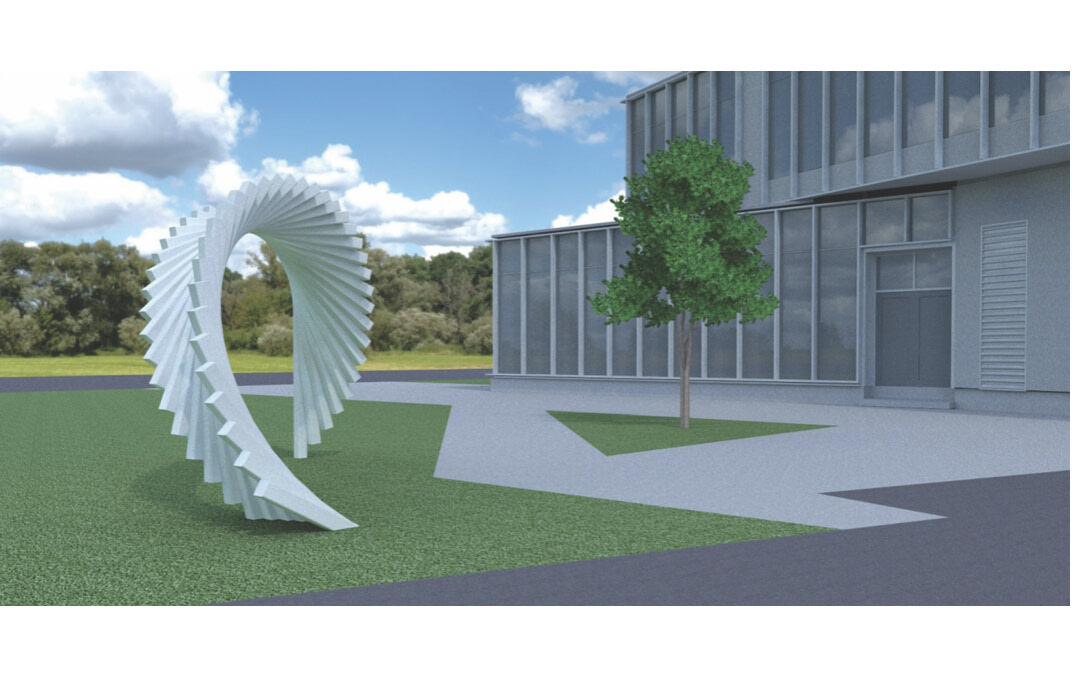
A public art piece called Ensemble, created by Montreal artist Patrick Bérubé, who has ties to the region through an earlier installation at the Cégep de l'Outaouais, has been chosen to anchor the new Aylmer police station, with installation and an inauguration planned for fall 2028. Photo: Courtesy of the City of Gatineau
Public art piece Ensemble selected for new Aylmer police station
Tashi Farmilo
Ensemble has been selected for integration into the architecture and surroundings of the new police station in Aylmer, the City of Gatineau announced. The piece is the work of artist Patrick Bérubé. It is expected to be produced over the next two years, with installation and an inauguration planned for fall 2028.
Built from a series of interlocking pieces, Ensemble is meant to stand as a symbol of togetherness, drawing residents into a shared meeting point right at the station's doorstep. Shaped like an arch, the piece leans on repeating forms that mirror the building's own lines, shifting in appearance depending on where a passerby stands to take it in.
Bérubé already has ties to the region: his 2014 installation Écho-Gnition remains on display at the Cégep de l'Outaouais in Gatineau, giving residents a chance to see his earlier work before Ensemble arrives in Aylmer. From Montreal, he built his foundation with a master's degree in visual and media arts from the Université du Québec à Montréal, completed in 2005. Twice a finalist for the Pierre Ayot Prize, he has built an international reputation through shows and events in cities such as New York, Berlin, London and Luxembourg. He co-founded the artist collective Pique-Nique and shows his work through the ArtMûr gallery.
Over more than a decade, Bérubé has built a substantial body of public and architecturally integrated work across Quebec, with pieces at Montreal's Sainte-Justine hospital and Laval's Maison des Arts. His momentum has only grown recently: he was tapped to design a sculptural centerpiece for a new linear park along Montreal's Rue Larivière, with jurors praising how the piece traces the surrounding neighbourhood's architecture and streetscape. He was also chosen by the Conseil des arts et des lettres du Québec and Bibliothèque et Archives nationales du Québec to create a permanent sculpture for the national archives building in Sept-Îles.
His artistic practice tends to dig into the tension between people and their surroundings, touching on memory, repetition and transformation, often carried with a sense of fragility and human vulnerability.
The selection followed a competition Gatineau launched to bring a piece of public art to the new station, part of a broader cultural policy goal of strengthening local identity and civic pride. Entries had to stand in three dimensions, rise up from the ground, invite public viewing, fit naturally with the building's design, and reflect current thinking in public art. Judges landed on Bérubé's proposal unanimously, calling it a strong fit for the site.
Isabelle N. Miron, who chairs the city's Commission des arts, de la culture, des lettres et du patrimoine and represents the Orée-du-Parc district on council, framed the project as proof of Gatineau's commitment to building spaces where architecture and creativity work together for the community's benefit. "Through its interconnected forms, Ensemble becomes an open door to a united community," she said.