


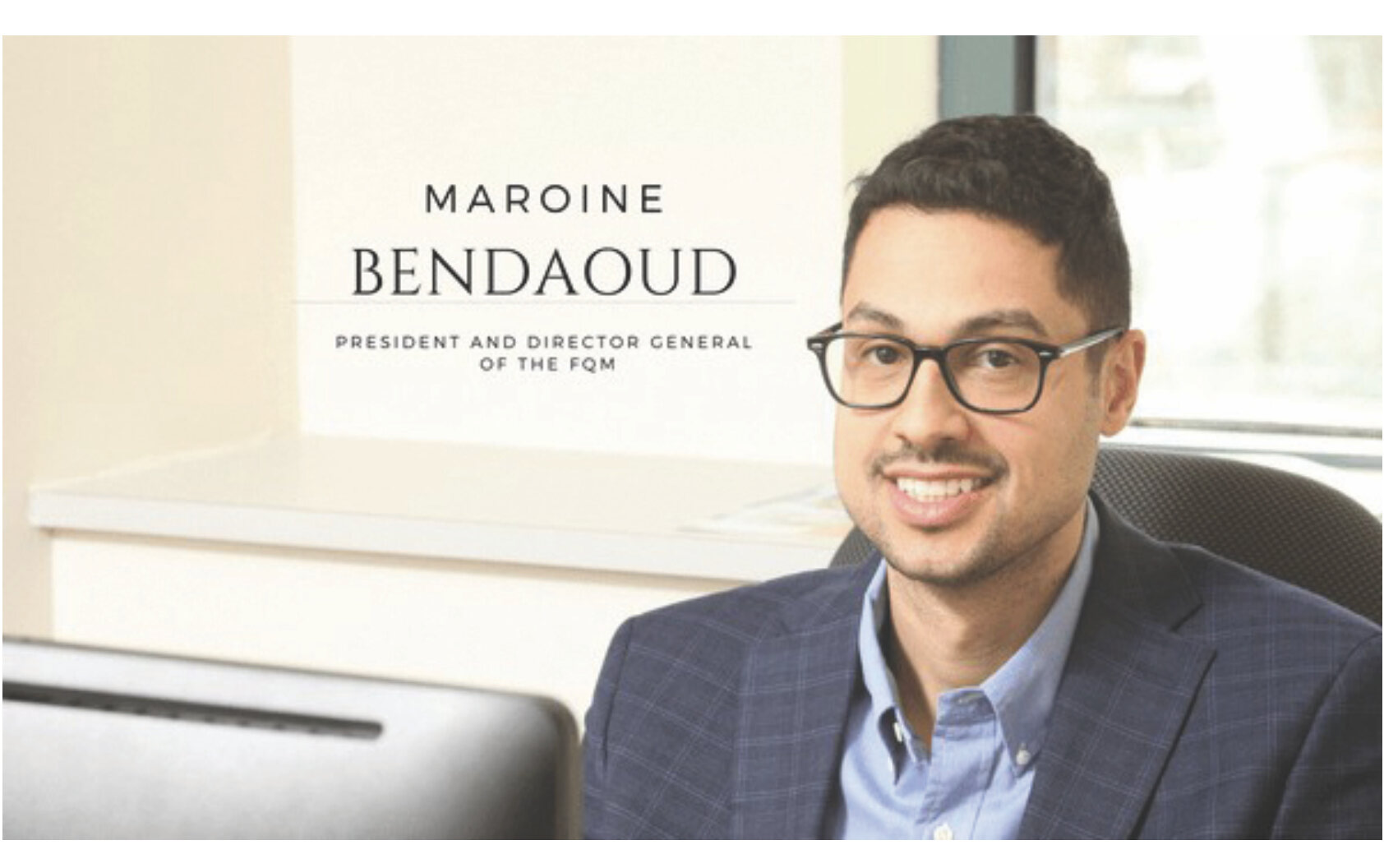
Maroine Bendaoud, PhD, president and chief executive officer of the Fédération québécoise des massothérapeutes agréés, says six Quebec associations have already built a shared registry of expelled members and drafted a title-protection law modelled on Nova Scotia’s, but need political will from the new government to give clients in the Outaouais and across the province the safeguards Ontario residents already have. Photo: Courtesy of the Fédération québécoise des massothérapeutes agréés
Quebec massage therapists need a protected title, federation head says
Tashi Farmilo
Six Quebec massage therapy associations are lobbying the province’s incoming government for a law that would stop anyone from calling themselves a massage therapist, and the head of the Fédération québécoise des massothérapeutes agréés (FQM) says the class action alleging sexual assaults at Nordik Spa Village in Chelsea shows why the gap needs closing.
In an interview with the Aylmer Bulletin, Maroine Bendaoud, the federation’s president and chief executive officer, said the associations have already done much of the groundwork themselves. What is missing, he said, is political will.
Quebec Superior Court Justice Enrico Forlini authorized the class action against the spa on October 2. Court filings say 143 people came forward between August 2025 and July, with allegations involving at least 36 massage therapists over a period stretching from 2007 to this year. The claims have not been tested in court, and Nordik has said the ruling is not a decision on their merits and that it will present its defence. The case is to proceed in the Gatineau judicial district.
“The accusations are very, very dramatic, scandalous,” Bendaoud said, adding that while some therapists who worked at the spa have been convicted in the past, most of what is alleged remains unproven. “Of course this is very sad.”
In his view, the associations’ disciplinary tools work when they are put to use. When the federation learns of an allegation against a member, whether from a spa, the police or a client, its syndic, a criminal lawyer, opens an investigation that can end with the member being struck off, he said, and the federation works with police when warranted. The weak link, he said, is that clients do not always come forward to the associations. He said anyone can call the FQM to ask whether a named therapist is a member, and staff will answer yes or no.
The deeper problem Bendaoud describes is structural. Massage therapy falls outside Quebec’s Professional Code, so a therapist expelled from one association has long been able to join another, or simply keep practising with no affiliation at all. He said the province has too many associations and the field is badly fragmented.
Since January 1, the six largest associations have shared a common registry of expelled and banned members, exchanging names and dates of birth so a therapist struck off by one group cannot quietly sign up with another. Bendaoud said the registry was not a reaction to the Nordik case. “We were already working on it,” he said, calling the old arrangement “a big flaw in the system.”
The broader proposal, launched in May, would go further. Drafted jointly by the FQM, the Réseau des massothérapeutes professionnels du Québec, Groupe RITMA, the Association québécoise des thérapeutes naturels, the Association des massothérapeutes du Québec and the Alliance des massothérapeutes du Québec, it calls for a law protecting the title of massage therapist, modelled on legislation Nova Scotia passed in 2019. The associations estimate they represent about 95 per cent of practitioners in a province with roughly 20,000 massage therapists. “We needn't reinvent the wheel,” Bendaoud said.
Under the proposal, new graduates would need at least 1,000 hours of recognized training. Bendaoud said Quebec currently has the shortest basic training in Canada, at about 400 hours, while Ontario and British Columbia require far more, close to 3,000 hours in British Columbia by his estimate. Therapists already practising would keep the title if they have at least 550 hours, with five years to reach that threshold if they fall short. Title holders would also need liability insurance, 25 hours of continuing education every three years and membership in good standing with a participating association.
Associations would have to check criminal records before admitting members, and Bendaoud said those checks would be renewed every year. Complaints involving sexual misconduct, fraud or violence would be handed in their entirety to an investigator who is a member of the Barreau du Québec, removing the matter from the association itself. “We make sure that there’s no association that can close its eyes on this matter, for whatever reason,” he said.
For clients, the most visible change would be a single public list. Today, anyone wanting to check a therapist’s standing must search the membership directory of each association separately, a process Bendaoud called far too cumbersome for the public. The law would require associations to publish their members, with the aim of letting people look up a name and see whether that person is entitled to the title.
For Outaouais residents, the contrast sits across the river. A client in Ottawa can look up a registered massage therapist through a provincial regulator; a client in Aylmer or Hull has no equivalent. Bendaoud said the associations chose title protection rather than seeking a professional order like those in Ontario and British Columbia because an order did not have consensus among the six groups. The federation says recently created orders have taken more than 15 years on average to establish, and that the FQM still hopes to obtain one in the long run.
The proposal has backing beyond the associations. Bendaoud said insurers support it, and that an association representing about 50 Quebec spas, Nordik among them, has sent a letter of support.
The politics have proved harder. Bendaoud said the associations lobbied the five main parties ahead of the October 5 election and that only one committed to regulating the field along these lines. The Parti Québécois, which now forms a minority government, did not, he said.
He acknowledged the law would not reserve the act of massage itself. Someone unwilling to meet the criteria could still offer massages under another label, he said, pointing to “bodywork practitioners” in British Columbia. But because insurers reimburse treatment only when it is provided by association members, and spas would be expected to hire title holders, he called the bill a potential “game changer.”
“Is it going to eradicate 100 per cent all forms of sexual violence? No, of course not,” Bendaoud said. The goal, he said, is to make every step, from training to admission to discipline, harder to slip through.