


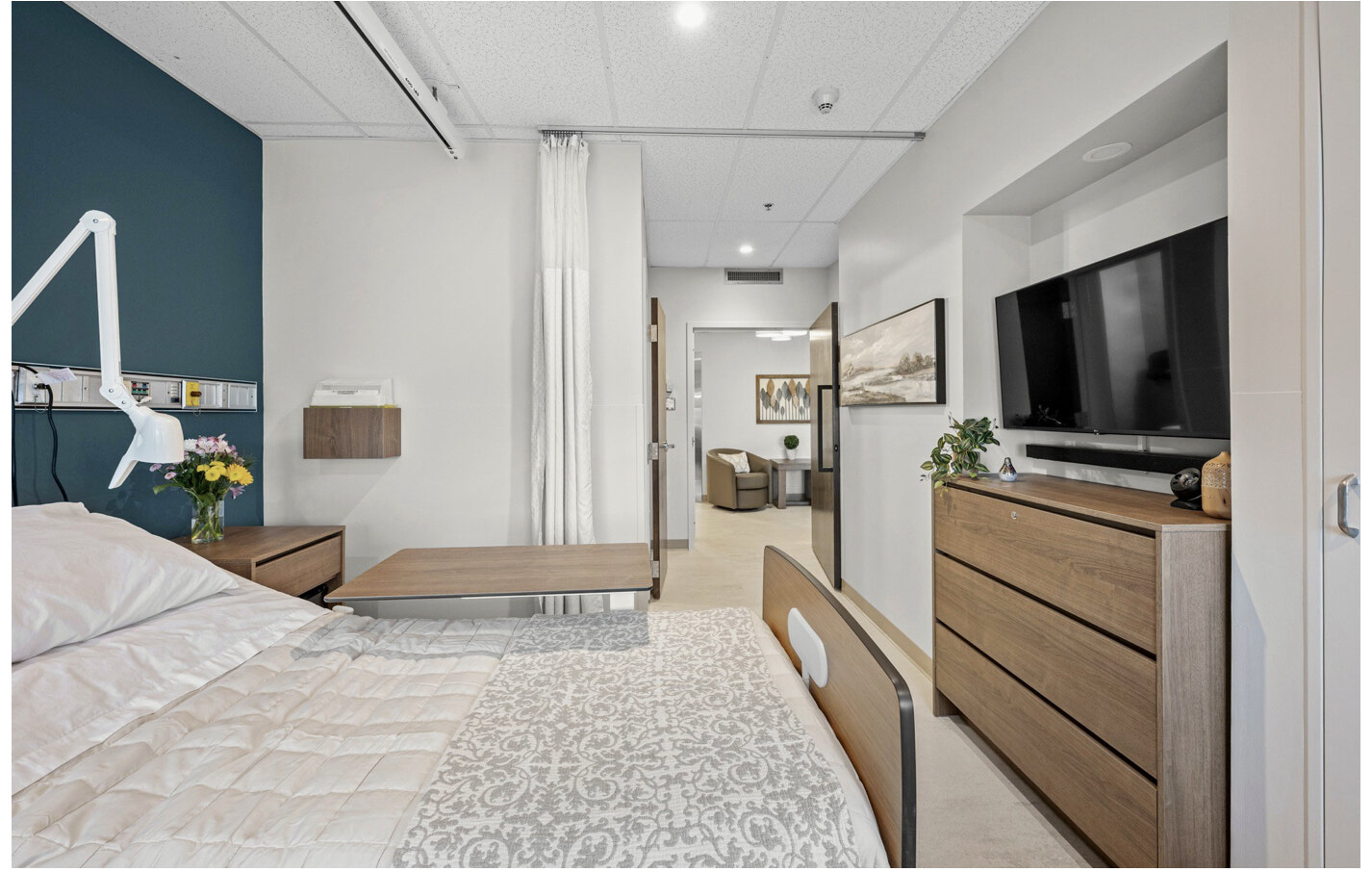
Action Santé Outaouais says Quebec's 2026-2027 budget, the eighth consecutive from the current government, contains no new commitment to closing a healthcare funding gap that leaves the region $348 million below the provincial average per population and sends more than $117 million in public health spending across the border to Ontario each year. Photo: Courtesy of Santé Québec
Quebec's latest budget leaves Outaouais health care gap unaddressed
Tashi Farmilo
For decades, residents of the Outaouais have crossed the Ottawa River to receive medical care that should have been available on th e Quebec side. The region's hospitals are underfunded; its clinics are understaffed; and its wait times are among the longest in the province. The Quebec government has acknowledged the problem in writing, and in 2019, the National Assembly adopted a motion formally recognizing a significant lag in public health funding in the region. Seven years later, the problem has not been fixed, and last week's provincial budget did not fix it either.
Action Santé Outaouais (ASO), a health care rights organization based in Gatineau, released figures on March 19 that illustrate the scale of the gap. Drawing on data from the Observatoire du développement de l'Outaouais, the organization calculates that the funding shortfall between what the Outaouais received and the Quebec-wide average reached $348 million in 2023, nearly double what it was just a year earlier. For a region of roughly 400,000 people, that gap translates directly into fewer nurses, fewer specialists, longer waits, and a health-care network that consistently operates beyond its means.
The cost of that shortfall is visible in Quebec's own accounts. ASO reports that Quebec's public health insurer, the RAMQ, spent $117.9 million in 2024 reimbursing care that Outaouais residents received at Ontario hospitals because adequate services were not available locally, a figure that has climbed 25 per cent since 2020. Every dollar spent at an Ontario hospital is a dollar that does not go toward building capacity on the Quebec side of the river. In 2025, when Santé Québec announced $90 million in cuts to the regional network, local organizations pushed back and the cuts were reduced to $45 million.
Against that backdrop, the 2026-2027 budget increases Quebec's overall health and social services spending by 4.1 per cent. ASO, citing research from the Institut de recherche et d'informations socioéconomiques, argues that this increase roughly matches the estimated four per cent annual rise in what it costs to simply maintain the existing system. There is no new money for the kind of structural reinvestment the Outaouais needs. The organization called the budget the eighth in eight years from the current government to pass without a concrete commitment to closing the gap the legislature recognized in 2019.
A further concern raised by ASO is a performance-based funding model being rolled out by Santé Québec across the provincial health network. The model ties a portion of funding to measurable efficiency targets, comparing results across regions. ASO argues the Outaouais cannot be compared fairly to other regions. No other part of Quebec is simultaneously managing decades of accumulated underfunding, a severe shortage of health-care workers, and the competitive pull of Ontario, where salaries and working conditions draw medical staff across the border.
On infrastructure, ASO notes that the Quebec Infrastructure Plan 2026-2036 allocates $1.6 billion to health facilities in the Outaouais over the decade, comprising $330 million for maintenance of existing buildings and $1.2 billion for new construction and expansion. That envelope covers work at the CHSLD des Collines and the Centre d'hébergement de la Vallée-de-la-Lièvre, as well as the long-awaited Centre hospitalier affilié universitaire de l'Outaouais. ASO questions whether $1.6 billion is enough to deliver all of that within the decade. The hospital project alone was estimated at $1.4 billion five years ago, before construction costs rose sharply across the province. The organization also reports that the Outaouais currently lacks roughly 400 long-term care beds, a number it projects will grow to 1,500 by 2040 even after the new Maisons des aînés already in the pipeline are completed.
With a provincial election set for October 5, 2026, ASO and a coalition that includes the Conférence des préfets de l'Outaouais and more than 20 regional organizations are pressing all parties for a three-year reinvestment commitment: $150 million in the first year, $305 million in the second, and $462 million in the third. Those figures represent between 0.2 and 0.7 per cent of Quebec's total health spending for 2026-2027.