


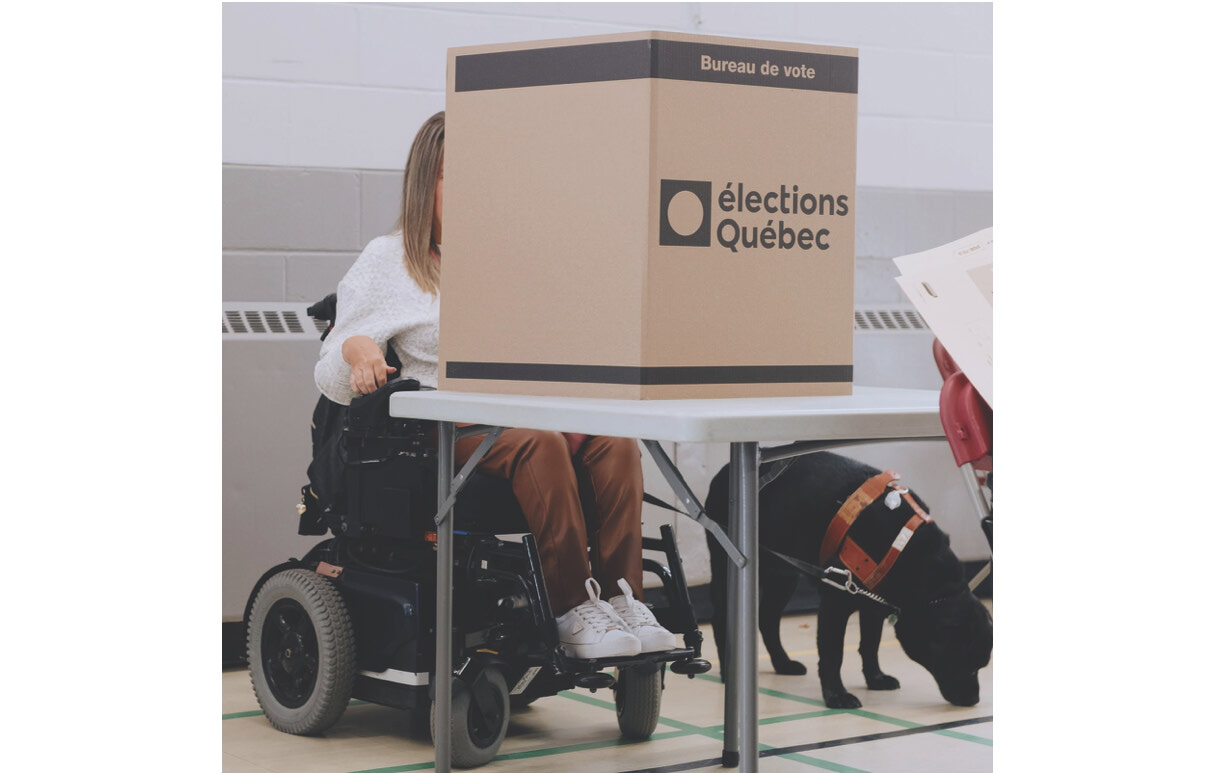
Élections Québec will mail voter information in French only for the first time in a general election, prompting the anglophone advocacy group TALQ to demand a return to bilingual mailings and raising the question of whether the change places a barrier in front of a right the constitution says governments cannot suspend. Photo: Courtesy of the Élections Québec Facebook page
TALQ urges Élections Québec to keep voter information bilingual as French-only mailings begin
Tashi Farmilo
TALQ, the advocacy group for English-speaking Quebecers, is pressing Élections Québec to abandon its plan to mail voter information in French only during the current provincial campaign, warning on September 1 that the change could keep some citizens from the ballot box ahead of the October 5 election.
For the first time in a general election, the mailings Élections Québec sends to every household, a guide to voting, a notice confirming who at an address is on the voters list, and a card reminding electors when and where to cast a ballot, will go out in French alone, printed with a QR code that leads to English material on the agency's website. Households that once received the same information in both languages by mail will no longer. English-language documents can be had only on request, and only by two groups: voters certified as eligible for schooling in English, and Indigenous electors, both of whom have to reach out to the agency and identify themselves as qualifying.
The agency has framed the move as an obligation, not a choice. Spokesperson Julie St-Arnaud-Drolet said the decision follows from the law. A 2022 statute, formally titled An Act respecting French, the official and common language of Québec, rewrote parts of the Charter of the French Language and made French the language the province's public bodies must use to communicate with the public. St-Arnaud-Drolet said Élections Québec will work harder to connect with anglophone and allophone voters as the campaign unfolds.
For TALQ, the former Quebec Community Groups Network, led by president Eva Ludvig, the fight is about reaching the ballot, not about which language prevails. In a letter to chief electoral officer Jean-François Blanchet, the group asked him to bring back bilingual mailings sent straight to voters. TALQ said it does not dispute French's standing as Quebec's official language, instead argued that the system running elections ought to make voting easier to reach rather than harder, calling this a question of democratic participation instead of language politics. Asking people to scan a code or file a request, the group cautioned, could hit hardest for older voters and anyone who struggles with technology or extra red tape.
The Charter of Rights and Freedoms promises every citizen the right to vote, and it is one of the few guarantees the notwithstanding clause is powerless to set aside. Section 33 lets a government wall off a law from challenges rooted in fundamental freedoms, legal rights and equality, but its reach stops short of democratic rights, mobility rights and minority language rights. Bill 96 leaned on that clause in advance to blunt such challenges, and yet it cannot touch the right to vote laid out in section 3. Opponents of the mailing policy say it burdens a right that no legislature is allowed to switch off. Its defenders reply that nobody is being barred from voting, since the English version is only a scan or a phone call away.
The consequences will not land evenly, and few parts of Quebec have more at stake than the Outaouais. The 2021 census found that 19.1 per cent of the region gave English as the first official language they speak, the third-largest share of any region in the province behind Nord-du-Québec and the Island of Montreal, and a figure that has surely climbed over the preceding five years. It runs deepest in the Pontiac riding, where Statistics Canada listed Shawville and L'Isle-aux-Allumettes among Quebec's most anglophone communities, each with close to 99 per cent of residents able to carry on a conversation in English. These are the very homes now getting a French-only card in the mail.
Élections Québec says the voting guide and the notice of who is registered should reach every address by the week of September 14, followed by the reminder cards in the week of September 28, all ahead of the October 5 election that will decide 127 seats in a legislature running on a freshly redrawn electoral map. Whether the agency backs down or sticks to the strict wording of the language law, the row has already turned an ordinary mailing into a test of how far the province's protections for French extend into the act of voting.